

A Landmark Visit Redefining Saudi–U.S. Relations
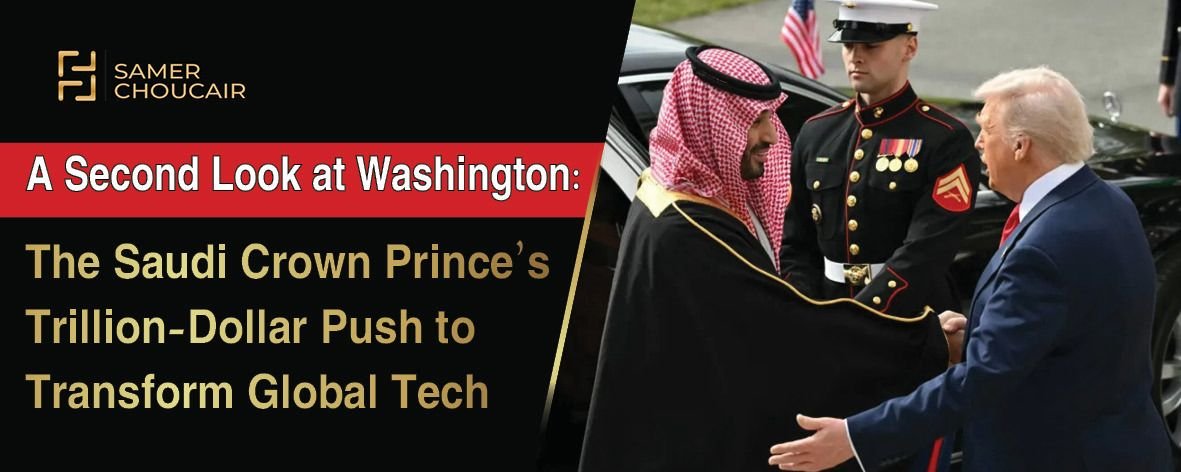
The visit of His Royal Highness Prince Mohammed bin Salman bin Abdulaziz Al Saud, Crown Prince and Prime Minister of Saudi Arabia, to the United States—at the official invitation of President Donald Trump—marks a pivotal moment in the evolution of bilateral relations.
More than a diplomatic exchange, the visit represents the launch of a forward-looking framework to engineer the Kingdom’s economic, defense, and technological future.
The ceremonial welcome at the White House, featuring a cavalry escort, aerial salutes, and a 19-gun tribute, reflected the strategic magnitude of this visit. It also signaled a shift toward a modernized partnership that goes beyond traditional oil dynamics and aligns with the transformative ambitions of Saudi Vision 2030.
—
Opening a New Chapter of Strategic Cooperation
Prince Mohammed bin Salman’s visit reaffirmed his essential role in driving Saudi Arabia’s long-term national strategy. The discussions in Washington strengthened mutual trust and expanded the scope of collaboration across high-impact sectors.
The Saudi–American summit produced several milestone agreements, including:
A Strategic Defense Agreement
A Memorandum of Understanding on Artificial Intelligence
Civil Nuclear Energy Cooperation Agreements
These agreements reflect the Kingdom’s intention to engage as a partner of strength—leveraging its economic scale, capital resources, and regional leadership to pursue shared strategic interests.
—
$1 Trillion Investment Vision: Accelerating the Global AI Race
A central highlight of the visit was the Crown Prince’s announcement that Saudi Arabia aims to increase its investments in the United States to $1 trillion, focusing significantly on:
Semiconductor manufacturing
Artificial intelligence ecosystems
High-tech infrastructure and innovation
This trillion-dollar strategy underscores a critical shift: Saudi Arabia seeks not only to benefit from advanced technologies but to acquire, localize, and co-develop them.
The AI memorandum of understanding positions the Kingdom at the heart of the global intelligence-technology value chain—a sector expected to shape global competitiveness for decades to come.
—
Defense Modernization and Civil Nuclear Capacity
Complementing the tech-driven investment strategy, the Crown Prince focused on strengthening defense readiness and enhancing peaceful nuclear energy capabilities.
During the visit, the United States approved a major defense package that includes:
48 F-35 advanced fighter jets
Nearly 300 American tanks
Frameworks for military co-manufacturing and joint technology development
Reinforced by the Strategic Defense Agreement, this modernization enhances the Kingdom’s military resilience and provides the stable foundation required for sustained economic growth.
Parallel to this, new agreements on civil nuclear energy cooperation support Saudi Arabia’s long-term plans to diversify its energy mix, promote sustainability, and harness safe nuclear innovation for domestic development.
—
A New Era of Private-Sector-Driven Partnership
One of the most significant dimensions of the visit was the unprecedented scale of private-sector engagement.
An investment forum at the John F. Kennedy Center for the Performing Arts gathered over 400 CEOs from leading American and Saudi companies.
This high-profile gathering emphasized:
Direct investment channels
Innovation-driven industries
Sectoral partnerships aligned with Vision 2030
The signing of an agreement to streamline Saudi investments in the U.S. further illustrates a shift toward building commercial, scalable, long-term partnerships rather than symbolic engagements.
—
Conclusion: Leadership Crafting the Architecture of the Kingdom’s Future
Prince Mohammed bin Salman’s visit to Washington symbolizes Saudi Arabia’s transformation from a nation that imports solutions to a country that actively helps shape the future of global technology, defense, and energy.
Through concrete deliverables—ranging from the F-35 acquisition to AI collaboration and civil nuclear agreements—the Crown Prince demonstrated a leadership model focused on measurable outcomes, national strength, and sustainable progress.
The visit reinforces a defining message:
Saudi Arabia is confidently advancing toward a new era of economic power, security stability, and technological leadership—rooted in national interest and powered by strategic global partnerships.