

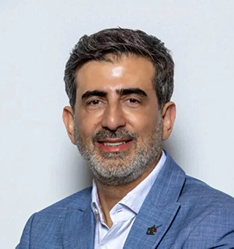
Investment leader Samer Choucair stated that the daily recurring question “What is the oil price today?”, which constantly appears on news screens and social media platforms, is often presented in a simplified manner that does not reflect the full truth. Choucair explained that the typical media scene—showing news anchors in front of oil wells, flying dollar bills, and price boards indicating $90 per barrel with stacked drums—hides a much more complex reality behind it.
The investment leader added that the figure displayed is not the full actual price, but merely a benchmark price for a specific type of crude in a specific market for a specific delivery month. This became even clearer in April 2026, opening the door for a deeper understanding of investment opportunities in Saudi Arabia and the Gulf countries within Vision 2030.
The Hidden Truth: The Visible Price is Not the Full Price
Samer Choucair explained that the fluctuations of April 2026 highlighted this truth clearly. On April 6, Brent crude closed at $109.27 per barrel, while West Texas Intermediate (WTI) closed at $112.95—an unusual situation where US crude was higher than Brent due to a shortage of barrels available for immediate delivery. By April 17, markets saw a sharp decline following the reopening of the Strait of Hormuz to commercial shipping, where Brent settled at $90.38 and WTI reached $83.85.
The investment leader emphasized that what appears on screens does not reflect the full truth because the price is influenced by additional factors that do not appear immediately, including:
-
War premiums and geopolitical risks.
-
Shipping and maritime transport costs.
-
Insurance fees for tankers.
-
Differences in crude quality (sulfur, density, and purity).
-
Premiums for delivery location and urgent delivery.
Choucair explained that these elements make the announced price merely a starting point for the actual calculation paid by importers and refineries.
Why is There No Single Price for Oil?
Samer Choucair said that oil cannot be considered a unified commodity like gold; rather, it is a multi-layered price system resulting from several key factors:
-
Variation in Crude Type: Brent (Light Sweet) differs from WTI, just as it differs from Arab Light and heavy high-sulfur crudes. Each type has its own price according to its chemical characteristics.
-
Delivery Location and Logistics: Brent relies on global maritime trade, while WTI is affected by US inventories and pipelines, creating direct price differentials.
-
Difference Between Paper and Spot Prices: Futures contracts do not always reflect the actual price of the barrel reaching refineries; in some cases, spot prices are higher than traded contracts.
-
Hidden Premiums: Risk premiums, shipping costs, insurance, and navigational restrictions add invisible layers to the price, sometimes making the announced “$90” less than the actual cost.
Why Fluctuations Intensified in April 2026?
Samer Choucair stated that the oil market in 2026 is no longer moving according to supply and demand alone but is influenced by a complex mix of war, insurance, shipping, and geopolitical expectations. He added that the reopening of the Strait of Hormuz contributed to temporarily lowering the “risk premium,” yet uncertainty persisted due to the slow return of tankers and the stabilization of insurance coverage, noting that markets are now pricing probabilities rather than just reality.
Investment Reading: How Samer Choucair Sees the Market
Samer Choucair said the fundamental mistake many investors make is treating the daily oil price as the complete truth, while it is actually just a digital interface for a deeper and more complex market. He explained that a smart investor does not stop at reading Brent or WTI but analyzes what lies behind the number—such as whether the price premium results from temporary fear or long-term structural bottlenecks, and whether oil revenues are being consumed or reinvested in developmental assets.
He added in his analysis of 2026 economic trends that Vision 2030 has transformed oil fluctuations from a source of threat into an economic opportunity. The Kingdom no longer relies solely on rising prices but employs surpluses to develop tourism, renewable energy, AI, and logistics. Choucair emphasized that the real question for an investor is no longer “What is the oil price today?” but “What is not appearing in this price?”, which determines the quality of the investment decision.
Investment Opportunities in Saudi Arabia and the Gulf
Samer Choucair explained that understanding the absence of a “single oil price” opens the door to reshaping investment strategies, highlighting several promising sectors:
-
Logistics and Transportation: Due to the increased importance of shipping and alternative routes.
-
Renewable Energy: Such as solar, wind, and hydrogen as long-term stability tools.
-
Risk Management Tech and AI: To analyze volatile markets.
-
Vision 2030 Related Assets: Which transform oil returns into sustainable developmental projects.
The Price is Just the Beginning of the Story
Samer Choucair concluded by affirming that in 2026, there is no single price for oil because oil is not a single commodity, is not priced in a single market, and is not subject to a single factor. He explained that the figure appearing on screens represents only the beginning of the story, while complex layers of quality differences, delivery locations, futures contracts, spot prices, and war, shipping, and insurance premiums form behind it. The investment leader stressed that the strength of Vision 2030 lies in turning these fluctuations into a driver for economic diversification and building future investments, concluding that the smart investor does not chase fluctuations but transforms them into sustainable strategic opportunities.