


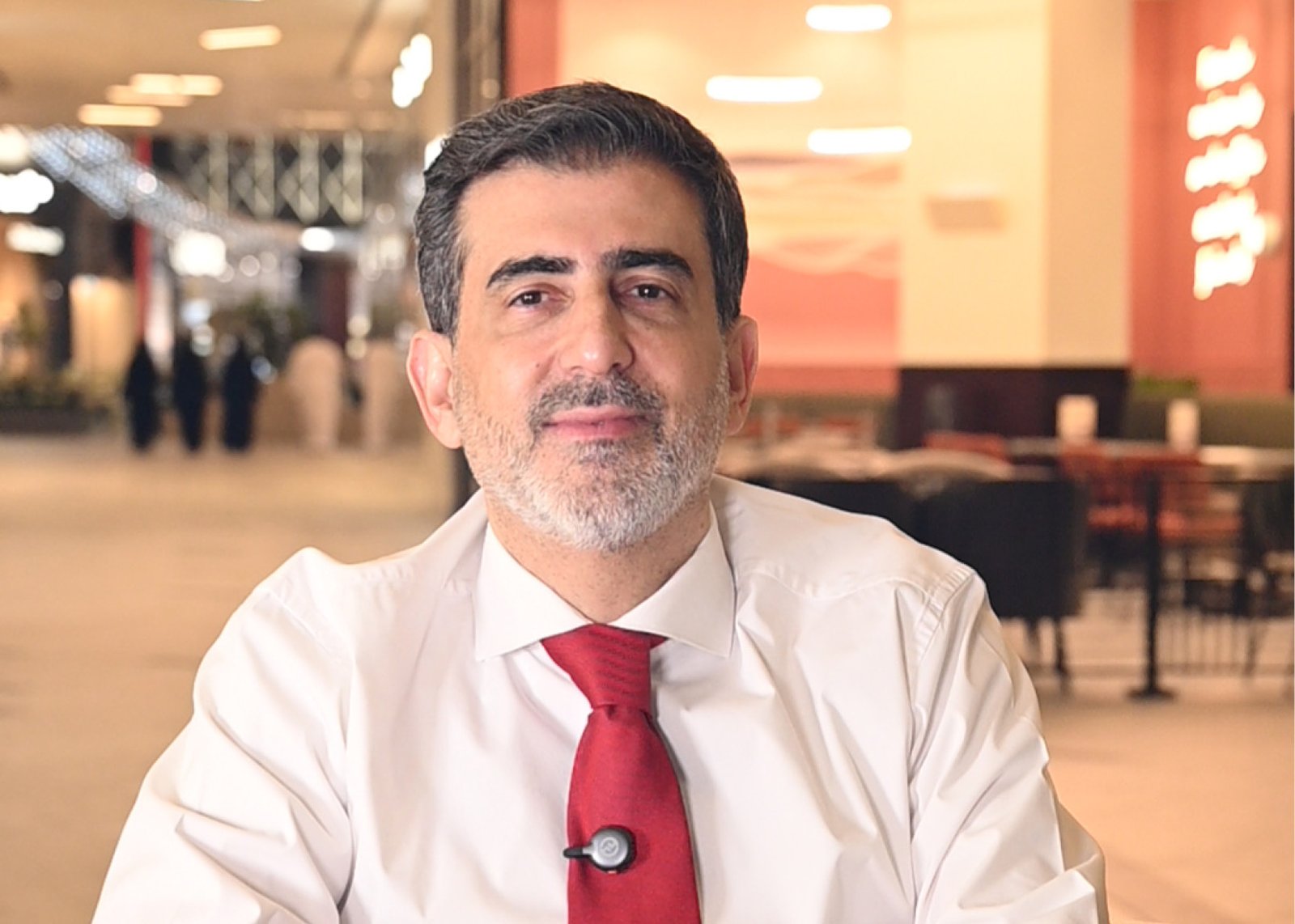
Samer Choucair Explains
Investment entrepreneur Samer Choucair stated that the sharp volatility recently witnessed across global markets, driven largely by escalating geopolitical tensions with Iran, has once again highlighted the critical importance of risk management in modern investing.
Choucair noted that major hedge funds, including Millennium Management, reportedly suffered losses of approximately $1.5 billion within a single week, effectively wiping out most of their annual profits.
He explained that such developments remind investors that investing is not only about generating profits. It is fundamentally about maintaining a careful balance between risk and return.
According to Choucair, one of the most powerful tools used by professional investors to control risk is understanding asset correlation and actively reducing it within investment portfolios.
What Are Hedge Funds and the “Pod Shop” Model
Choucair explained that hedge funds are investment vehicles designed to generate positive returns regardless of market direction, whether markets are rising or falling.
Unlike traditional funds that primarily rely on buying equities, hedge funds employ sophisticated strategies such as short selling, derivatives trading, and market neutral positioning to manage risk and enhance returns.
Many of the world’s largest hedge funds operate under what is known as the multi manager structure, often referred to as Pod Shops.
Under this structure, a fund is divided into independent teams known as pods. Each team is led by a portfolio manager specializing in a specific strategy such as equities, fixed income, commodities, or macro trading.
Choucair explained that the goal of this structure is to achieve genuine diversification by reducing correlation between different strategies.
Correlation measures how closely two investment strategies move together. If correlation is high, as is often the case between traditional portfolios and the S&P 500, losses can occur simultaneously, which weakens the benefits of diversification.
When correlation is low, however, portfolios are able to achieve more stable returns with lower volatility.
Lower Correlation Is the Real Key to Diversification
Choucair warned that high correlation represents what he described as the hidden enemy of diversification.
Research shows that even a modest correlation of around 10 percent between several strategies can reduce the Sharpe ratio, a measure of risk adjusted return, by nearly half after operational costs are taken into account.
The danger becomes even greater during financial crises, when different asset classes tend to move in the same direction. This phenomenon is often referred to as correlation convergence.
This pattern was clearly visible during the Global Financial Crisis, when diversified portfolios across global markets experienced simultaneous losses.
Choucair added that reducing correlation does not only improve portfolio performance. It also contributes to greater stability within the global financial system. When investment portfolios are better diversified and less correlated, the likelihood of synchronized market collapses decreases significantly.
He pointed to diversification strategies implemented by the Public Investment Fund, which allocates investments across multiple sectors and asset classes in order to reduce reliance on oil market volatility as part of the broader economic transformation under Saudi Vision 2030.
Economic Examples That Explain Hedging and Correlation
Choucair explained that the concept of hedging and correlation can be understood through practical economic examples.
In agriculture, for example, a wheat farmer may use futures contracts to sell his harvest in advance at a fixed price. This allows the farmer to protect himself from price fluctuations at the time of harvest. In this case, the futures contract acts as a hedging instrument that reduces risk.
Another example is pairs trading, where investors take advantage of strong correlations between assets. Traders may analyze currency pairs such as the euro dollar and the pound dollar and profit from temporary pricing imbalances while limiting overall portfolio risk.
Choucair also noted that during periods of crisis investors often move toward safe haven assets such as gold or government bonds, which tend to move inversely to stock markets. During the global pandemic, for instance, gold prices rose sharply while many global equity markets declined.
Lessons From Financial History
According to Choucair, financial history offers numerous examples that demonstrate the importance of understanding asset correlation.
During the Global Financial Crisis, correlations between many asset classes suddenly surged, resulting in large losses for institutions that believed they had diversified their portfolios effectively.
By contrast, renowned investor George Soros generated enormous profits in 1992 by betting against the British pound, exploiting contradictions between the policies of the Bank of England and prevailing market conditions.
Choucair also noted that developments in March 2026 showed how some multi manager funds experienced losses due to rising correlations during geopolitical shocks. These events reinforce the importance of using advanced tools such as correlation heat maps to monitor portfolio risk in real time.
Global Leaders in Hedge Fund Management
Choucair pointed to several prominent investors who have successfully developed hedge fund models designed to reduce correlation between strategies.
Among the most notable figures are
Ken Griffin, founder of Citadel, one of the largest multi strategy hedge funds in the world.
Steve Cohen, founder of Point72 Asset Management, known for employing market neutral strategies to produce returns independent of market direction.
Israel Englander, founder of Millennium Management, who pioneered the pod model to distribute risk across independent investment teams.
The Future of Investing: Artificial Intelligence and Tokenization
In conclusion, Choucair stated that reducing correlation between investment strategies is no longer merely a financial technique. It has become a central pillar in building portfolios capable of withstanding global economic volatility.
He explained that emerging technologies, including artificial intelligence driven financial analytics and real world asset tokenization, often referred to as RWA, will open new opportunities for investors to build smarter and more diversified portfolios.
Choucair emphasized that investors in the Arab world, particularly in Saudi Arabia, are uniquely positioned to benefit from these advanced portfolio management concepts.
He concluded by stating that the future will reward investors who are able to redesign their portfolios using scientific analysis, disciplined risk management, and a deep understanding of market dynamics.