

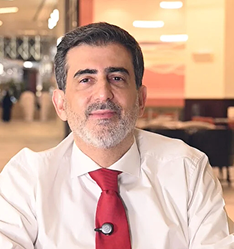
Investment pioneer Samer Choucair stated that at a moment where the brilliance of Bitcoin blends with the fog of geopolitics, this digital asset no longer moves in isolation from the world; instead, it has become an immediate reflection of global capital appetite. The investment pioneer revealed that on April 22, 2026, the currency surpassed the $78,000 barrier and approached $79.5 thousand, driven by a temporary de-escalation between the United States and Iran, which eased fears of escalation and restored confidence to the markets. Choucair added that this rise was not merely a fleeting price movement, but a signal of liquidity returning to seek risks when tensions subside.
Samer Choucair indicated in a statement that reading this scene should not be limited to it being a “crypto” story, but rather a model for understanding the movement of funds globally. When the probability of political shocks decreases, capital moves toward high-growth assets such as technology and digital currencies, rather than centering in safe havens. In this sense, the rise of Bitcoin reflects a shift in market mood toward pricing opportunities, not just risks.
Choucair pointed out that this rise was not driven by individual speculation alone, but by clear institutional support. Inflows returned to spot Bitcoin funds in the United States, with hundreds of millions of dollars within days, alongside massive purchase deals that raised the holdings of major institutions to record levels. Choucair emphasized that these indicators reinforce the idea that Bitcoin is no longer marginal; it has become part of the components of modern investment portfolios, despite its volatile nature.
Samer Choucair said that Bitcoin should not be treated as a substitute for traditional assets, but as a leading indicator of the direction of global liquidity. It reflects the interaction of three main factors: politics, technology, and institutional behavior. Hence, the smart investor does not view it as a separate bet, but as a tool for reading broader shifts in the global financial system.
Choucair noted that in this context, Saudi Vision 2030 emerges as a proactive model that does not bet on a single asset, but on building an integrated financial ecosystem. The Kingdom is working on developing the fintech sector, enhancing market depth, and attracting foreign investment, which reflects a trend toward transforming it into a regional platform for global capital, not just a recipient market for it.
Choucair indicated that the real opportunity, then, does not lie in chasing the rise of Bitcoin, but in understanding the message it carries. The world is repricing assets according to a complex balance between liquidity, technology, and geopolitical tensions. Whoever succeeds in reading this equation can build a more flexible portfolio that combines stable traditional assets with calculated exposure to the digital economy.
Choucair explained that the most mature strategy today is neither full immersion in digital assets nor ignoring them completely, but adopting smart diversification that balances stability and growth. In this way, Bitcoin becomes merely an early signal of market trends, not its center.
Samer Choucair summarized this vision simply: The true investor does not chase the price but understands what lies behind it. The rise of Bitcoin is not the goal, but the evidence of a deeper shift in the movement of global capital, which opens the door for investors to reformulate their strategies in line with a rapidly changing world.