

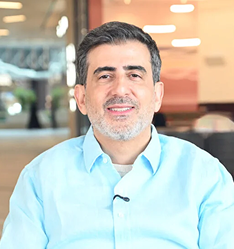
Investment leader Samer Choucair stated that the real question in the Saudi market is not whether the TASI index rises or falls, but rather where its returns are actually forming. The mental image that reduces the market to a massive moving figure hides a more complex mechanism behind it, where profits are not distributed equally, but are formed at specific points within certain sectors and within timings directly linked to the path of economic transformation led by Vision 2030.
The investment leader added in a statement that reading the data of the past five years clearly reveals that the market’s performance was not a single homogeneous line; in 2021, we witnessed a strong upward wave, followed by subsequent years of sharp fluctuations affected by global factors, before the market began to gradually reshape its balance. Samer Choucair explained that with the onset of 2026, it does not seem that opportunities have disappeared; on the contrary, they have become more precise and selective, as if the market is redistributing its gains to those who understand its new map, noting that the biggest mistake many investors make is dealing with TASI as a single block. He emphasized that the data says something completely different: real returns were not the result of owning the entire market, but the result of positioning within the sectors leading the economic transformation. Here appears the difference between those who chase the index and those who read it.
Samer Choucair noted that sectors associated with the new economy have proven to be the most important source of sustainable returns. Renewable energy and utilities benefited from massive investment flows toward sustainability, while the financial sector continued its growth driven by the expansion in lending and digital transformation. Samer Choucair said: “At the same time, telecommunications and technology strengthened their position thanks to the acceleration of Artificial Intelligence, while logistics and infrastructure transformed into a fundamental pillar in the Kingdom’s position as a regional trade hub.”
Samer Choucair continued, saying that, in contrast, some traditional sectors remained more vulnerable to fluctuations, especially those linked to commodity cycles. This variation does not reflect weakness in the market, but rather reflects its transformation. Returns are no longer coming from where they used to, but are moving gradually toward the sectors building the future of the non-oil economy.
The investment leader emphasized that what these data reveal is a new investment pattern; not every rise in TASI means an equal opportunity for everyone, adding that the general rise of the index may hide a large performance gap between one sector and another. Therefore, two investors could be within the same market, one achieving a return exceeding the average, while the other barely keeps pace with the index; the difference is not in entering the market, but in choosing where to stand within it.
Samer Choucair pointed out that in 2026, building an investment portfolio becomes a more complex and conscious process. It is no longer enough to invest in the market; rather, you must invest in the direction where value is created. Reading data is no longer a luxury but a necessity, and understanding the relationship between the numbers and Vision 2030 has become the decisive factor in determining who succeeds and who retreats.
Investment leader Samer Choucair concluded his statement by saying that the real returns of TASI are not seen on the surface; they are formed deep within the sectors that reflect the future of the Saudi economy. Those who realize this transformation will not suffice with chasing the movement of the index, but will become part of the forces that create this movement.