

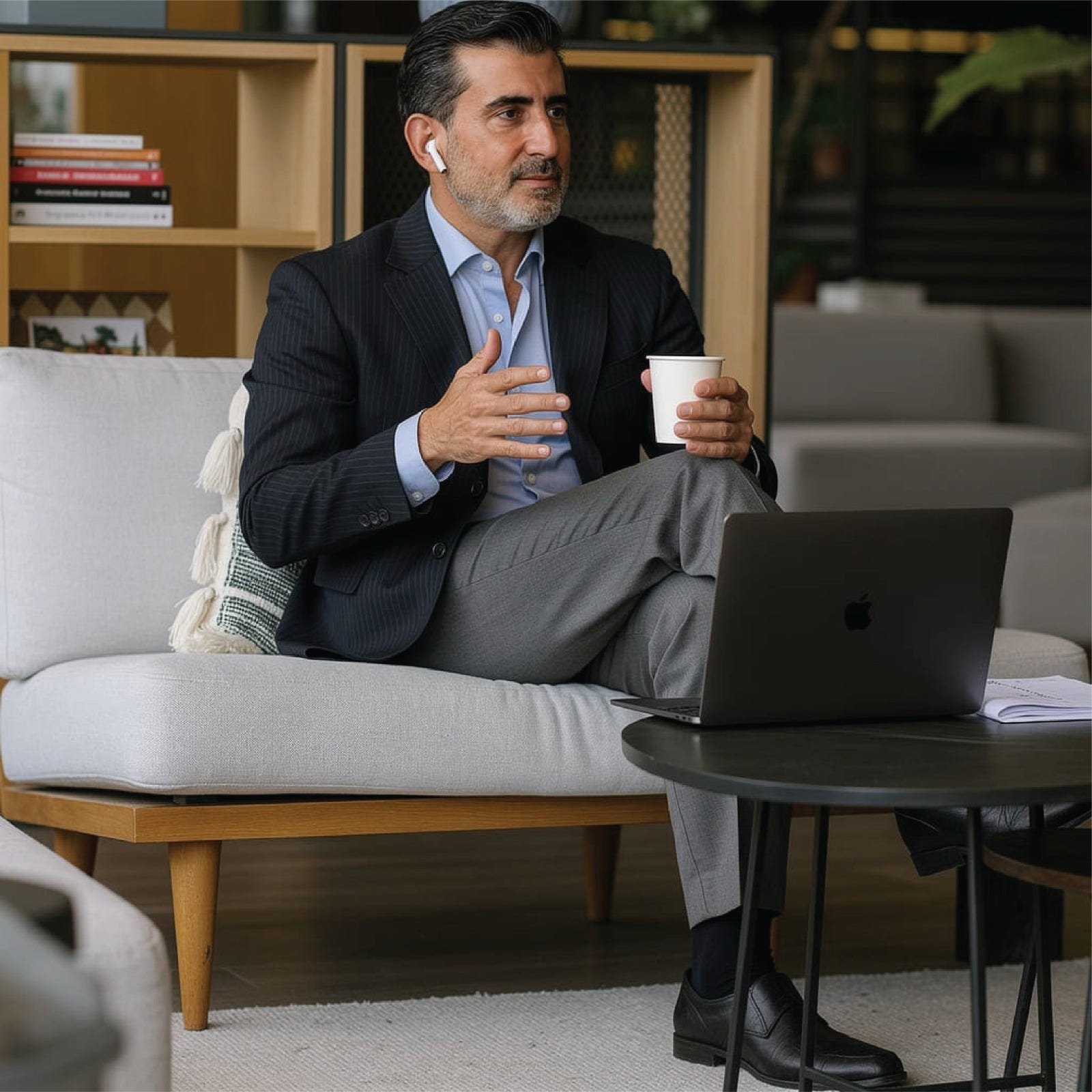
Investment pioneer Samer Choucair reflected on a striking image capturing the AI revolution, featuring Tiger Tyagarajan, former CEO of Genpact, alongside Ranjit Tinaikar, against a backdrop saturated with digital symbols. Choucair explained that he saw in this image a clear message for investors in Saudi Arabia and the Gulf: AI is no longer a threat to traditional revenues but has become a primary engine for growth in the era of Vision 2030. Choucair added that he followed the dialogue published by Newsweek within the “AI Impact Forum,” where the two global leaders discussed reshaping business models in light of the rapid transformation led by AI. Samer Choucair explained that he reviewed the journey of Tiger Tyagarajan, who led Genpact between 2011 and 2024, transforming it from a GE unit into a global company with revenues exceeding 4.5 billion dollars, expanding to more than 130,000 employees in 30 countries. Choucair added that Tyagarajan currently holds advisory roles in major investment institutions such as Boston Consulting Group and Bain Capital, alongside his membership on the boards of global tech companies. Choucair also pointed out that Ranjit Tinaikar, former CEO of Ness Digital Engineering, possesses long experience in digital transformation and leads strategic discussions on the future of AI and new business models. Samer Choucair said that he paused at a direct statement by Tyagarajan calling on companies not to fear “cannibalizing current revenues” through AI, explaining that hesitation in transformation could mean losing competitiveness entirely. Choucair added that this vision reflects a radical shift in management thinking, where maintaining the traditional model is no longer a safe option, but rather internal transformation has become a necessity for survival. Samer Choucair emphasized that he sees in these shifts a strategic opportunity aligned with the Kingdom’s path, explaining that AI has become the “new operating system for the global economy,” and not just a technical tool. Choucair pointed out that Saudi Arabia, within the framework of Vision 2030, possesses an ideal environment to adopt this transformation, especially in the energy, finance, and logistics sectors. Samer Choucair identified a set of investment trends that will lead the next phase, most notably predictive AI, tokenization of real assets, and human-machine collaboration models. Choucair explained that these trends coincide with massive investments in digital infrastructure within the Kingdom, enhancing its position as a regional hub for innovation. Samer Choucair explained that the true value lies in transforming these global visions into local applications, noting that investors in the Kingdom can benefit from this transformation by restructuring traditional business models. Choucair added that the greatest opportunities are concentrated in smart energy, digital financial services, and AI in healthcare and e-commerce, noting that investing in AI-backed startups represents one of the most important growth drivers in the next phase. Samer Choucair provided a set of practical recommendations for investors, most notably adopting boldness in restructuring businesses instead of clinging to old models. Choucair advised focusing on sectors that integrate AI into the core of their operations, alongside building diverse investment portfolios that combine traditional and digital assets, pointing to the importance of benefiting from government initiatives and strategic partnerships provided by Vision 2030 to support digital transformation. Samer Choucair concluded his talk by saying that he saw in the warnings of global leaders a clear call for swift action, confirming that AI is no longer an additional option but has become the foundation of the new economy. Choucair added that the Kingdom of Saudi Arabia, with the support of Vision 2030, possesses a historic opportunity to transform this global shift into a long-term competitive advantage, noting that those who dare to change today will lead the markets of tomorrow.