

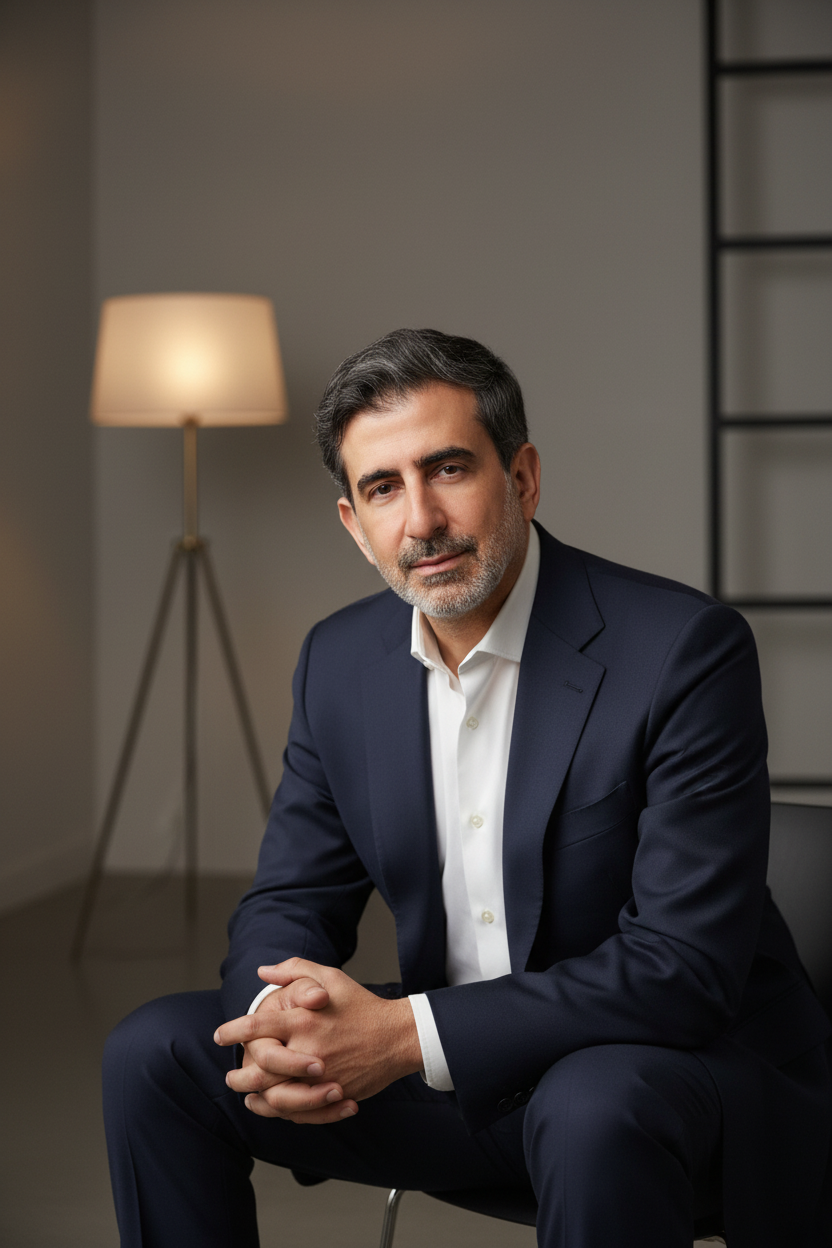
Investment pioneer Samer Choucair explained that the scene of sitting behind the wheel of a luxury car, while a panoramic screen and an intelligent system seamlessly understand your preferences, is no longer just a futuristic vision, but has become a tangible reality since April 2026.
Choucair pointed out that what General Motors presented in its advanced interior design is no longer a luxury element, but has become part of a radical shift in the concept of the car itself.
Strategic Shift: From a Car Company to a Technology Platform
Samer Choucair mentioned that General Motors announced the expansion of its use of Google technologies, specifically integrating Gemini capabilities into the driving ecosystem for millions of existing vehicles, in addition to 2022 models and beyond—Cadillac, Chevrolet, Buick, and GMC—equipped with the Google Built-in system in North America.
Choucair emphasized that this step was not a passing technical update, but a redefinition of asset value in an industry valued at trillions of dollars.
OTA Updates: Transforming the Fleet into Living Digital Assets
Samer Choucair explained that the company has already begun rolling out Over-the-Air (OTA) updates to a fleet of nearly four million eligible vehicles, where the traditional Google Assistant is being gradually replaced by the more advanced Gemini system.
Choucair pointed out that these updates allow for natural conversations and deep digital personalization, stressing that implementation is being carried out in stages, but it reflects a clear trend: the car is no longer a fixed asset that erodes over time, but a software platform capable of continuous development.
Asset Repricing: The Car as a Platform that Grows Over Time
Samer Choucair emphasized that this shift represents what he described as the most important practical application of the asset repricing theory in the mobility sector.
Choucair explained that software updates do not only extend the life of the car, but also raise its market value and open new revenue streams through subscriptions and digital services.
Choucair added that this model resembles what happened with smartphones and Software-as-a-Service (SaaS) platforms, where the car has become a “living” asset that improves with every update.
The Cabin Economy: A New Market Born Inside the Car
Samer Choucair pointed out that integrating Gemini into the car opens the door to what is known as the “cabin economy,” which includes voice commerce, smart contextual advertising, and advanced digital services.
Choucair emphasized that this economy could compete with app stores within 5 to 7 years, transforming every driving trip into a continuous economic opportunity.
Data: The Most Valuable Asset in the Coming Phase
Samer Choucair explained that every interaction inside the car generates high-value behavioral data, which is used to improve algorithms and enhance competitiveness.
Choucair pointed out that value is no longer just in selling the car, but in owning the resulting data and turning it into decisions and strategies.
Geopolitical Dimension: A Technical Race and Regional Opportunities
Samer Choucair noted that the United States seeks to strengthen its superiority by integrating major technology companies with the automotive industry, while China is advancing rapidly in this field, especially in AI-powered electric vehicles.
Choucair emphasized that the Gulf, particularly the Kingdom of Saudi Arabia, represents an open market that can absorb these technologies and develop local solutions that compete globally.
Saudi Arabia and Vision 2030: Integration with Digital Transformation
Samer Choucair explained that this development intersects directly with the goals of Vision 2030, especially in the fields of smart cities such as NEOM and Riyadh, where integrating AI into mobility is a fundamental part of the infrastructure.
Choucair pointed out the role of the National Strategy for Data and AI in supporting the building of advanced local ecosystems, in addition to the importance of localizing value chains, as software has become more important than physical components.
Investment Opportunity Map: Where is Capital Heading?
Samer Choucair provided a clear vision for investors, explaining that opportunities are distributed across several levels:
-
Investing in major platform companies leading AI.
-
Automotive companies transforming into software companies.
-
Technical value chains such as electronic chips, operating systems, and cybersecurity.
-
Local opportunities in Saudi Arabia, especially startups in Arabic-language AI and mobility data platforms.
Choucair emphasized that the highest potential returns lie in these high-risk local opportunities.
Samer Choucair’s Vision: A Shift in the Definition of Value
Samer Choucair stated that what is happening is not just an evolution in cars, but a shift in the definition of value itself, noting that the updateable car has become an asset that improves over time.
Choucair added that the real opportunity in the Gulf does not lie in importing technology, but in re-developing it locally, transforming the region from a consumer to a producer.
Risks: Challenges that Must Be Managed Intelligently
Samer Choucair pointed out that this shift carries risks, including high dependence on major technology companies, data privacy issues, and security challenges, in addition to the gap between the speed of innovation and regulation, emphasizing that these challenges create investment opportunities in the fields of cybersecurity and compliance.
A Strategic Window for the Kingdom and the Gulf
Samer Choucair concluded his analysis by emphasizing that integrating Gemini into General Motors vehicles represents a turning point in the automotive industry, a comprehensive repricing of assets, and the beginning of a new economy inside vehicles.
Choucair explained that this moment opens a historic opportunity for Saudi Arabia and the Gulf to transform from technology consumers to its creators, stressing that the true value is no longer in owning the car, but in owning the system that runs it.