

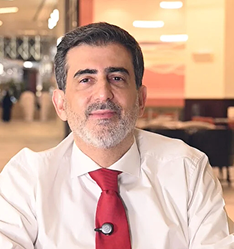
Investment pioneer Samer Choukeir stated that in April 2026, the Strait of Hormuz returned to the forefront of the global scene as a true choke point for energy markets. This follows escalating tensions between the United States and Iran, reaching levels that disrupted shipping and repriced risks at an unprecedented pace.
In a statement, Samer Choukeir added that the discussion is no longer about an ordinary maritime passage, but about an artery through which a massive portion of global oil and gas supplies flows. With near-total disruption in transit and rising insurance costs, this was immediately reflected in prices, which surged strongly, bringing Brent crude close to $95 per barrel amid significant daily gains.
The investment pioneer pointed out that this scene cannot be read solely from a market perspective; it must be understood within a broader strategic context. For Saudi Arabia, rising prices provide important financial support, but simultaneously reinforce the logic of economic transformation based on diversifying income sources and reducing oil dependence. Here, the importance of investing in this price cycle emerges—not as a temporary opportunity, but as a lever to build a more balanced and sustainable economy.
Choukeir explained that what is happening today is a true test of investor awareness, distinguishing between those attracted by quick profits and those who realize that true value lies in redirecting liquidity toward the sectors of the future.
He continued: “From this perspective, Saudi Arabia is not measured only by its oil production volume, but by its ability to transform surpluses into productive projects that enhance long-term growth.” He emphasized that the smart investor in 2026 does not treat oil as a standalone story, but as part of a broader system linked to energy, industry, technology, and services.
Choukeir indicated that within this framework, multiple investment opportunities are unfolding. In the energy sector, opportunities are not limited to traditional production but extend to advanced industries, energy efficiency, and the transition toward cleaner sources. He added, “In logistics, the disruption of vital corridors raises the value of investment in infrastructure and supply chains, giving the Kingdom an additional advantage in developing its ports and economic zones.”
The investment pioneer stressed that in financial markets, recent regulatory openness enhances the attractiveness of the Saudi market as a regional hub attracting capital seeking stability.
In his statement, Samer Choukeir called for avoiding hasty reactions and instead pursuing a studied repositioning based on a balance between short-term gains and long-term vision. The current stage requires selectivity in exposure to the energy and logistics sectors, while strengthening investment in sectors linked to local growth and economic diversification, alongside continuous monitoring of geopolitical developments as a key risk indicator.
Samer Choukeir concluded his statement by saying: “The fog covering the Strait of Hormuz does not represent a state of absolute ambiguity as much as it is a moment of testing. While some see it as a source of concern, the strategic investor sees it as an opportunity to reposition and build stronger centers.”
He added: “From this standpoint, Saudi Arabia appears to be in a position that is not limited to benefiting from high prices, but extends to employing this moment to accelerate its transformation toward a more diversified and resilient economy, capable of turning crises into engines for sustainable growth.”