

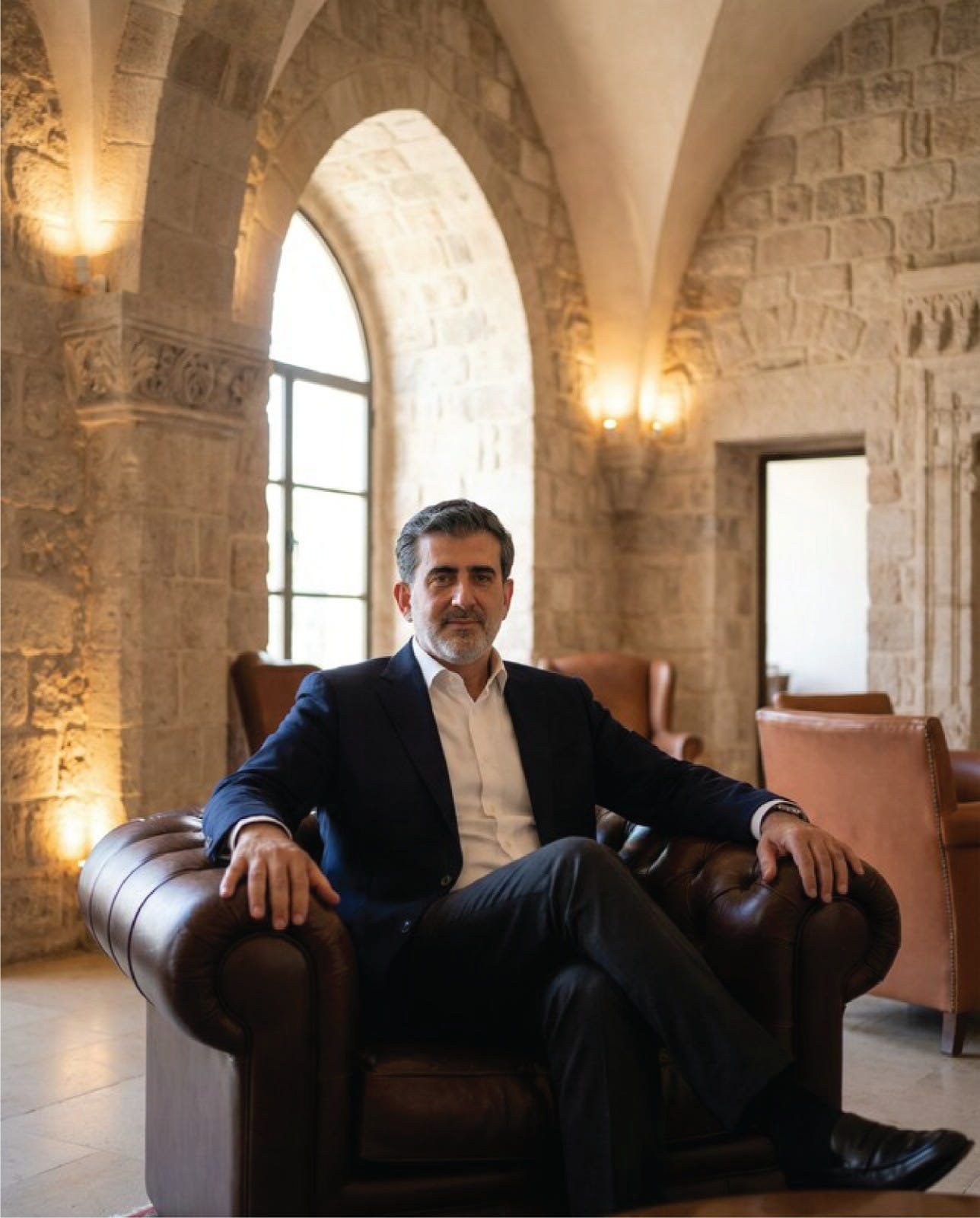
Investment pioneer Samer Choucair explained that the image published by Newsweek magazine in late April 2026, showing the world’s wealthy moving away from the face of Benjamin Franklin on the US dollar toward a new horizon, was not merely an artistic expression, but a manifestation of a profound strategic shift.
Choucair pointed out that ultra-high-net-worth individuals (UHNWIs), whose wealth exceeds $30 million, were reshaping their wealth distribution, announcing the end of the era of near-total reliance on the United States as the sole investment hub.
The Fundamental Shift: From Concentration in America to Global Diversification
Samer Choucair mentioned that recent data, especially the Knight Frank Wealth Report 2026, showed a growth in the number of ultra-wealthy individuals by 29.5% between 2021 and 2026, reaching 713,626 individuals, at a rate of 89 new people daily crossing the $30 million threshold.
Choucair added that projections indicated their total wealth would reach more than $80 trillion by 2030.
Choucair stressed that more important than the numbers is the change in behavior, as these investors began distributing their assets across 3 to 5 geographic regions, instead of concentrating between 70% and 80% in the United States as was previously common.
Choucair pointed out that the Henley & Partners 2025 report tracked the relocation of 142,000 millionaires to other countries, with expectations of the number rising to 165,000 in 2026, emphasizing that this trend was not an escape, but a repositioning in search of what he described as a “stability premium.”
Why Did the Wealthy Re-evaluate the US Market?
Samer Choucair explained that several factors drove this shift, noting that the tax environment in states like California and New York was witnessing increasing pressure with rising taxes and the debate over imposing wealth taxes, which affected net returns.
Choucair added that the state of political and geopolitical uncertainty, along with the continuous change in policies with every election cycle, pushed investors to look for global alternative plans.
Choucair noted that restrictions imposed on the movement of capital and technology, including tightening oversight on foreign investments, were limiting the freedom of investors.
Choucair emphasized that the old model based on high concentration in a single market has become a risk, leading the wealthy to adopt more balanced distribution strategies.
The New Capital Map: Rising Destinations in 2026
Samer Choucair pointed out that this shift opened the way for new regions to lead the scene, as the Gulf countries, led by the Kingdom of Saudi Arabia and the UAE, emerged as primary destinations for global capital.
Choucair added that Singapore strengthened its position as a stable Asian hub, while Southern European countries appeared as attractive options through residency-by-investment programs; however, he emphasized that Saudi Arabia is no longer just an investment destination, but has transformed into a market maker and a magnet for capital, thanks to profound economic transformations.
Saudi Arabia: A Global Investment Platform Driven by Vision 2030
Samer Choucair explained that the Kingdom achieved a remarkable transformation, as the non-oil sector contribution reached about 55% of the real GDP.
Choucair added that the Public Investment Fund (PIF) contributed more than $243 billion to the growth of this sector between 2021 and 2024, representing about 10% of the total non-oil GDP in 2024 and one-third of its growth.
Choucair pointed out that the fund invested more than $199 billion in new domestic projects between 2021 and 2025, bringing its assets under management to approximately $900 billion, emphasizing that reforms included facilitating the entry of foreign investors through the QFI program, alongside the move toward asset tokenization, and support for major projects in tourism, smart cities, renewable energy, and technology.
The investment pioneer explained that this model combines high growth, stability, and government support, which attracts capital seeking real returns with calculated risks.
Samer Choucair’s Vision: The End of the Single Center and the Beginning of Investment Networks
Samer Choucair emphasized that what is happening was not an exit from the United States, but an end to the idea of relying on a single center, noting that capital has begun searching for environments that provide freedom of movement, clarity of rules, and returns linked to real growth.
Choucair added that the smart investor no longer chases markets, but seeks to build networks of relationships within emerging economic systems, explaining that investment in the Gulf often begins with building the relationship before completing the deal.
Choucair pointed out that Saudi Arabia has become a key player in shaping global markets, especially in the fields of artificial intelligence, infrastructure, and luxury tourism.
Direct Investment Opportunities in the Gulf
Samer Choucair mentioned that there are several promising paths for investors, including partnership in PIF projects, investment in real estate with the trend toward asset tokenization, in addition to investment in technical infrastructure and artificial intelligence, pointing to the tourism and hospitality sector, especially major projects like NEOM and the Red Sea, which provide long-term return opportunities.
Important Correction: Not an Escape from America, but a Rebalancing
Samer Choucair stressed that there are no indicators of a mass escape from the United States, explaining that it still holds about 35% of the world’s UHNWIs, compared to 33% in 2021.
Choucair emphasized that what is happening is a redistribution of risks and the building of multinational investment strategies, rather than a break with the American market.
The Beginning of a New Era for Global Capital
Samer Choucair concluded his analysis by emphasizing that the world is not witnessing the end of the United States, but the end of its monopoly on global capital.
Choucair explained that the Kingdom of Saudi Arabia is moving rapidly to become one of the most prominent centers for investment and wealth in the coming decade, supported by Vision 2030 and structural reforms.
Choucair pointed out that the opportunity has become available for investors in the Gulf to build sustainable wealth, emphasizing that the essence of investment in the region is based on understanding relationships before numbers, which makes it more attractive in the era of mobile capital.