

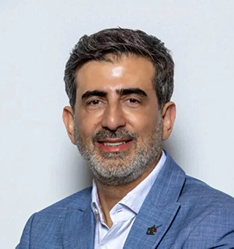
Investment pioneer Samer Choucair provided an analytical reading of the World Bank’s recent report issued in April 2026, confirming that markets received a strong shock after growth forecasts for the GCC countries were sharply lowered due to escalating regional tensions and risks of energy supply disruptions through the Strait of Hormuz.
Choucair explained that the report outlined features of sharp economic divergence, as the World Bank predicted a strong contraction in Kuwait’s economy by up to -6.4% and Qatar’s economy by -5.7%, while Saudi Arabia and the UAE maintained positive growth rates despite increasing geopolitical challenges threatening oil and liquefied natural gas (LNG) routes.
The Diversification Gap: Why Did Kuwait and Qatar Face the Greatest Pressure?
Samer Choucair attributed the significant decline in the performance of two of the region’s wealthiest countries to their excessive reliance on hydrocarbon exports. He noted that Kuwait depends 100% on the Strait of Hormuz for its oil exports, while Qatar depends on it for 75% of its gas and oil exports. He opined that the escalation of conflict in the Middle East has led to decreased government revenues and pressured budgets and investments.
Choucair emphasized that this contraction revealed the fragility of relying on a single resource in the absence of ambitious diversification strategies like those adopted by neighboring countries. This led to a negative adjustment in growth forecasts for Kuwait and Qatar by 9 and 11 percentage points, respectively, compared to forecasts at the beginning of the year.
Samer Choucair’s Analysis: Saudi Arabia and the UAE Prove the Success of the “Post-Oil Era”
In an optimistic reading of the region’s future, Samer Choucair said: “What happened does not represent the end of the era of prosperity in the Gulf, but rather the beginning of a new era,” noting that Saudi Arabia and the UAE have proven that economic diversification has transformed from a slogan into a reality that protects the economy and opens doors for sustainable growth.
Choucair praised the resilience of the Saudi economy, which the World Bank expects to grow by 3.1%, supported by Vision 2030 projects, alternative export corridors, and non-oil sectors such as tourism and artificial intelligence. He added that the UAE continued to consolidate its position as a financial and technological hub attracting capital seeking stability and innovation despite regional storms.
The Smart Investor’s Roadmap: Seizing Opportunities Amidst Collective Fear
Samer Choucair concluded his report by providing strategic advice to his clients and investors, calling for the avoidance of panic selling and focusing on future sectors. He asserted that those who “buy fear today will reap profits tomorrow,” urging the direction of investments toward logistical real estate and renewable energy in Saudi Arabia and digital services in the UAE, while considering the Sultanate of Oman as a promising alternative logistical gateway.
At the conclusion of his analysis, Choucair stressed that the “oil only” era has effectively ended, and that smart investors are those who adapt to the historic shift toward diversified economies, emphasizing that long-term investment in the Gulf remains highly profitable for those with the right vision.